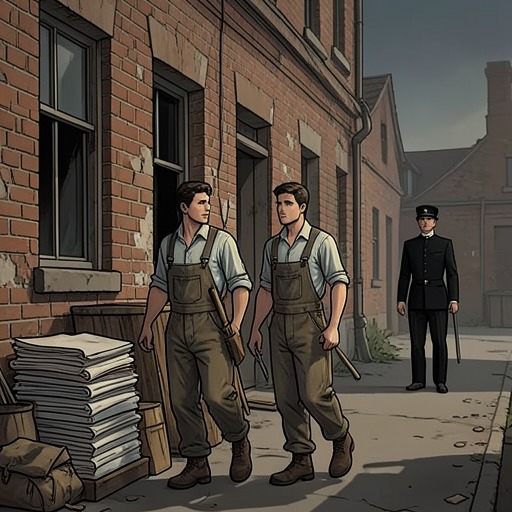
Minna Recruits the St. Vincent Boys into L&L Movers
Motherless BrooklynFrank Minna’s recruitment of Lionel Essrog, Tony Vermonte, Gilbert Coney, and Danny Fantl begins as a favor borrowed from St. Vincent’s Home for Boys and takes the form of an unexplained warehouse job. By the time Minna has handed the boys money and L&L Movers cards, the four have been drawn into a team whose public identity is moving work and whose deeper significance lies in what each boy hopes Minna’s attention will make possible.
Selection and First Contact
The boys were chosen by Mr. Kassel, a teacher who knew Frank Minna from the neighborhood. They were four of the five white boys at St. Vincent’s Home for Boys; the fifth, Steven Grossman, was excluded. Lionel later understood that he had been close to remaining among the library stacks: he seemed to the adults a poor prospect, a twitching, nose-picking boy rather than a promising recruit. The selection therefore begins not with a formal offer but with an adult’s judgment about which boys Minna might want to borrow.
Minna had asked for white boys to suit what he presumed were his clients’ prejudices, and perhaps his own. Lionel also allows that Minna may already have imagined reclaiming or cultivating the boys, but he cannot establish that motive. What the boys experienced was more immediate: on a sweltering August afternoon, Minna opened the rear of his dented, graffitied van, ordered them inside, then slammed and padlocked the doors without asking their names or explaining where they were going. The boys were giddy at being taken beyond the Home, even though they did not know what the excursion meant.
The group’s first hierarchy was already visible. Tony Vermonte, fifteen and older than Lionel and Gilbert, was its conspicuous leader; Danny Fantl was fourteen, while Lionel and Gilbert were thirteen. Tony told Lionel to stop making his repeated birdlike chirping sound, but without his usual conviction. In Lionel’s recollection, Tony was prepared to read the arrival of Minna as a sign of destiny: he had long expected Italians to come for him, in the guise of either mobsters or police, and saw no contradiction between those possibilities. His confidence and imagined rescue sharply contrasted with the other boys’ uncertainty.
The Warehouse Errand
After a mile or two, Minna’s van stopped in a gated yard in a ruined industrial area beneath the Brooklyn-Queens Expressway, later identified as Red Hook. Minna led the boys to a detached twelve-wheel trailer and opened it onto a cargo of identical sealed cardboard boxes, perhaps a hundred or two hundred. Lionel’s first response was to feel a thrill at the prospect of secretly counting them, an early expression of the compulsive counting and inspection that shaped his experience of the world.
Minna told the boys to move the goods into the warehouse, explaining the task as a straight run from the trailer to the building. Tony and Danny initially jumped into the truck, where they could work in the shade; Gilbert and Lionel made the first dozen trips across the hot yard. The older boys eventually joined them in dragging the boxes. Minna did not carry any. He stayed in the warehouse office, among desks, file cabinets, notes, pornographic calendars, and orange traffic cones, smoking and talking on the telephone behind a window. To the boys, the job was physical, exhausting, and opaque; Minna’s separation from the labor made the imbalance between employer and recruits plain.
When the work was done, Minna drove them to Smith Street, near the Home, bought Miller beer and soda, and sat with them in the van. The beer was Lionel’s first. Minna asked for their first names, beginning with Tony, but did not give his own. Lionel began tapping the van panel, and when the exertion and excitement ebbed, his symptoms returned. The first job ended without the boys receiving a clear account of what they had been moving or why. Its mixture of hard labor, withheld information, and a shared drink nevertheless marked their first outing as Minna’s recruits.
From Unnamed Labor to L&L Movers
Minna gathered the boys again the following week and took them to the same yard. The task was almost identical, down to a load of between 242 and 260 boxes. This time Minna was friendlier, but the boys still worked in wary silence. Lionel recalls Tony’s hostility toward him and Gilbert as if Tony feared they were obstructing his Italian rescue, while Danny remained largely exempt from the tension and oblivious to it. Repetition began to make the boys function as a team: the work’s shared physical demands gave them a practical connection before they had a settled understanding of their employer.
Afterward, Minna asked whether they liked the work and whether they knew what kind of work it was. Tony answered that it was moving boxes. Minna insisted on the name moving work, turning the boys’ unexplained labor into the stated business of a moving company. He took a roll of twenties from his pocket, handed each boy one, and offered them each a white card for L&L Movers. The card listed Gerard Minna and Frank Minna and gave a phone number. For Lionel, the twenty dollars was his first; for the group, the cash and business cards made the arrangement more legible without disclosing what the earlier cargo had been.
This naming matters because Minna did not merely recruit boys to carry boxes; he gave their activity an ordinary commercial description and a piece of printed evidence to carry away. His emphasis on calling it moving work established the cover under which they would labor. The recruits, who had arrived without knowing Minna’s name, now had a company name and contact details, while Minna remained the figure who defined what the job meant.
The Team’s Future and Tony’s Ambition
Lionel’s later account makes the recruitment consequential beyond the two warehouse trips. Tony was the first to catch Minna’s attention and the boy who most strongly fired his imagination. Minna seemed to see in the recruits the future Minna Men, a group of young men who could be cultivated and commanded; Lionel cautiously suggests that Tony’s yearning for an Italian rescue may even have helped prompt Minna’s ambitions for such a team. The recruitment thus joins Minna’s authority to the boys’ own desires rather than presenting it as a simple offer of employment.
The boys also learned from Minna beyond the job itself. Lionel recalls the Court Street women around Minna and how casually he invoked old school connections, teased them, and handled their attention. The boys watched his gestures and manner, storing them as lessons in a kind of worldly ease. In that sense, the work introduced them not only to Minna’s business but to the authority and masculine performance that surrounded him.
Tony’s later course gives the episode a darker retrospective edge. Lionel comes to understand that Tony wanted Frank Minna’s share of the Fujisaki scam and, more broadly, wanted to become a corrupt operator or wiseguy. He had been fitting himself for the darkest shoes in Minna’s wardrobe from the moment he understood they existed—possibly as early as the boys’ first work and their introduction to Matricardi and Rockaforte, perhaps earlier. After Minna’s death, Tony imagined occupying Minna’s roles with both the Clients in Brooklyn and Gerard Minna and the Fujisaki Corporation in Yorkville, but without Minna’s softness. The first recruitment therefore contains two divergent possibilities: Lionel’s lasting aspiration to be a virtuous detective and Tony’s desire to inherit the power behind the respectable business name.